Friday, May 23, 2014

Interesting Carrier News

Not all of our company-related posts are for Stupid Carrier Tricks© [ed: believe it or not]. Sometimes, there's just interesting announcements. For example:

■ In Special Open Enrollment news, United Healthcare has come out with its take on what counts as a Qualifying Event. What's interesting to me is that, for once, a carrier also explicitly details those things which don't trigger a Special Enrollment, most notably: "Voluntarily ending coverage."

Why is that so notable?


Because I've been getting a number of folks complaining about their existing plan's premiums, and wanting to switch (as if an ObamaTax-compliant plan is a real bargain). I've had to explain to them that, even if I could find less expensive coverage, it does them no good until next Fall.

As one who has seen Hospice Care up-close-and-personal, let me assure you that there are no finer people in the health care delivery system. What's a shame is that not everyone even knows about Hospice, or how to access their services. In fact, Dr. Randall Krakauer (a vice president at Aetna) recently testified before a Senate committee on Aging " urg[ing] senators to improve end-of-life benefits for patients in Medicare Advantage plans by changing the rules that govern use of hospice benefits. Medicare managers should let enrollees who seem to have as many as 12 months to live use hospice benefits."

Typically, Hospice services are available only to those who face imminent death, not a year away. Expanding that could relieve some of the burden from traditional health care facilities.


Our friend (and Long Term Care insurance guru) Randy G tips us that Genworth has made available an interactive map comparing cost of (long term) care across all 58 states.

Of course, I checked my own beloved Buckeye State, and saw that the average cost for a (semi-private) room in a nursing home is north of $75,000 a year.

Are you prepared?

Cavalcade of Risk #209: Call for submissions

Claire Wilkinson hosts next week's Cav. Entries are due by Monday (the 26th).

To submit your risk-related post, just click here to email it.

You'll need to provide:

■ Your post's url and title
■ Your blog's url and name
■ Your name and email
■ A (brief) summary of the post

PLEASE remember: ONLY posts that relate to risk (not personal finance tips and the like). And please only submit if you are willing to link back to the carnival if your submission is accepted.

Thursday, May 22, 2014

Just When You Thought it Couldn't Possibly Get Any Worse ...............

You run across this report on the Obamacare SNAFU:

The full extent of the failure, however, is reflected in the details provided by the Judicial Watch FOIA document revelations. They include:

  • On October 1, there were 43,208 accounts created and 1 enrollment. 
  • As of October 31, 2013, there were 1,319,425 accounts created nationwide -- but only 30,512 actual enrollments in Obamacare. 

Keep in mind that enrollment means someone selected a plan and put it in their shopping cart. It doesn't mean they actually applied for coverage ..................... or paid their premium.

A New Twist on an Old(er) Idea?

We've been blogging about Medical Tourism for going on 8 years. Generally, we've referred to two "flavors:"

1 - Foreign nationals taking advantage of what they perceive to be superior health care here in the US, and

2 - Americans traveling abroad for less expensive treatment, ostensibly as good as what's available here.

But there seems to be a new and growing trend: inter-state medical tourism.

Hunh?

Here's the idea:

"The phenomenon of this new trend in medical travel -- inter-state to Centers of Excellence (COEs) throughout the country and inbound to the U.S. – is largely the result of the impact of U.S. health reforms, employer receptivity to introducing a medical travel benefit, consumer willingness to travel to other parts of the United States to access quality care with improved outcomes, and increased demand for more cost-effective care"

Nate's discussed this idea before, that higher cost doesn't necessarily translate to better outcome. And there's a growing sense among employers that this is an area that can be addressed. Currently, it appears that only self-funded plans will be able to easily add this benefit, but one wonders if there'll be a move among the fully-insured crowd to do so.

One obstacle, of course, is the ObamaTax and its requirement for plan conformity. Perhaps this could be marketed as an "ancillary" benefit, available to groups (maybe even individuals) who are willing to pay for it.

Health Wonk Review: Life's a Beach edition

Good morning, and welcome to this edition of the Health Wonk Review.

In casting about for a theme suitable to the occasion, my mind wandered a bit (as it's prone to do this time of year), and I flashed on a serene stretch of sand and crystal clear water (and no, I did not have my hands wrapped around an ice cold Corona).

And so, I figured I'd share some moments of calm as we plunge into the best of the blogosphere's posts on health care polity and policy:


■ First up, a blast from the past: Jared Rhoads has transitioned from the more traditional blog platform to the v-log model (Mazel tov, Jared!). He last hosted the HWR back in January of 2012. In this vid-post, he presents the Urban Institute's Howard Gleckman discussing the challenges of financing Long Term Care.


Next, Chris Langston (Program Director of the John A. Hartford Foundation) offers his take on how the Center for Medicare and Medicaid Innovation (CMMI) might improve its effectiveness.

Bradley Flansbaum thinks that maybe the P4P (Pay for Performance) train has lost its caboose. He points out that the P4P phenomenon isn't an exclusively American idea: the Brits have been at it for a long time, "with mixed results."


HWR co-founder (and all around mensch) Joe Paduda ventures into Workers Comp territory (watch out, Julie!), ACA plan rate increases, Medicaid non-expansion and a few other interesting tidbits in this eclectic (and interesting) post.

Health care guru Roy Poses is concerned about how much money is being thrown at the boob-tube over the past few years in attempts to influence the public's perception of ObamaCare. He's also leery of the anechoic effect (which he introduced and explained way back in '06: "Why is it that folks can behave like such miscreants and everyone turns a blind eye?").

David Williams offers us the transcript of a podcast he recently did with the director of a new, not-for-profit effort designed to provide unbiased information to help patients choose physicians. It's called "The Doctor Project," and David's interview provides some background and a progress report.


I refer to Jason Shafrin as my favorite health care economist for a reason: he knows his stuff. This time out, he explores how the ACA's Medicaid enrollment expansion has affected even those states which didn't opt in to it.

For some reason, I always smile when I see posts from Wing of Zock. Ann Bonham, PhD (chief scientific officer at the Association of American Medical Colleges) offers her insights on the need to address sex differences in pre-clinical research that relies on cell and animal models (Whew!). I say: Viva la difference!

Julie Ferguson is one of my very favorite blog-buddies: she coordinates the HWR, helps me out when I run into glitches with the Cavalcade of Risk, and always has interesting, thought-provoking posts. This one's sure to take your breath away, perhaps literally, as she presents a last letter from a dying miner caught in a 1902 collapse, and takes to task public authorities both here and in Turkey for failing to safeguard the lives of contemporary miners. 

 ■ Louise Norris is another great blog-friend, and this week she offers her perspective on reference-based pricing. She explains how it's really just another way of looking at the difference between in- and out-of-network costs, and that the patient just needs to be more aware of them.

Harold Pollack interviews Sabrina Corlette, a Research Professor and Project Director at Georgetown University’s Health Policy Institute. They discuss how the new health insurance marketplaces are actually working: how many have paid their premiums, differences between the kinds of available insurance plans, the likely impact of the “Cadillac tax” on high-expenditure insurance plans, and more.

Finally, our own Kelley Beloff (a Certified Medical Office Manager) posts about the reality of physicians' wages. Spoiler: they're not as great as you've been led to believe.

Thanks for stopping by, and please make sure to join us again in 2 weeks over at Joe P's place.

Wednesday, May 21, 2014

You Are a Man, Not a Woman

Woe be unto you if you have an Obamacare plan and the government does not know your
gender.

A report that aired on Asheville, NC ABC affiliate WLOS on Tuesday detailed the plight of college student Shelby Higdon, who under ObamaCare was refused medicine because of a gender mix-up within the ObamaCare provider's system, which according to Higdon could not be fixed due to bureaucratic red tape. 
"When it was time to get my medicine, they told me that they couldn't give it to me because on my insurance I was registered as a man," Higdon said. 
Breitbart

Guess you need to borrow Tina Fey's bossy pants

Predictive Analytics (A Risky P & C Post)

So, a few weeks ago, I attended one of our carriers' annual sales meeting. This is a fun-filled afternoon of speakers discussing topics ranging from commercial automobile polices to surplus markets, loss ratios and liability umbrellas.

Oh yeah, and 5 minutes on life insurance.

Oddly enough, I always enjoy this meeting, primarily to put faces and handshakes with voicemails and intercompany emails. And this year, my curiosity was piqued by the introduction of a new (to me, anyway) term: Predictive Analytics (PA).

This is a risk-assessment tool that enables Property and Casualty companies to further refine the underwriting process. After the meeting, I spent a few minutes with the gentleman who had discussed the topic, and he agreed to put me in touch with one of his PA experts.

A few days later, I had the opportunity to spend about a half hour on the phone with Sam (not his real name - carriers are generally skittish about speaking on the record, which I can understand). In the event, Sam was forthright and interesting. Here's the low-down:

Predictive Analytics (aka "modeling") is used primarily on underwriting commercial (and sometimes other) risks. It really began in the 90's with personal auto policies; it's an extension of a concept called "risk segmentation" that's used in addition to more traditional categories.

Basically, PA delves more deeply into the financial and demographic data of a given risk (property or business). This goes beyond, by the way, just credit scores (which are the subject of some controversy in the industry). In commercial lines insurance, this could include information from the Bureau of Labor Statistics and even the Census Bureau.

Sam stressed that PA is useful in the aggregate, but (obviously) can't predict how an individual risk would behave; it's an indication of what's "likely" to happen, not what's "going" to happen. Which seems a lot like traditional underwriting (just because you have diabetes doesn't mean you're going to lose a limb). The difference is something called "univariate" versus "multivariate" analysis.

Yikes.

Univariate analysis is generally used in traditional underwriting: things like construction (steel vs wood), protection class (is it near a fire hydrant) and occupancy.  These are looked at individually and summed up.

Mulitvariate analysis uses these, but then adds in financial, demographic and other information and - most importantly - how all of these factors interact with and affect each other.

And then there's the "secret sauce:" each carrier has its own formula for determining what weight to give each of these factors and how they interrelate: what's the propensity for a loss to which this information leads you? This will differ from carrier to carrier. That's why, for example, Company A might say "no thanks, we're not writing that" and Company B might say "hey, we'll give you a great rate!"

Sam also stressed that these models have to be constantly updated, as data and relationships change over time with the change in a carrier’s book of business. The models are (as noted above) customized for each carrier, but there's a bit of a catch to that:

There's a limited pool of Subject Matter Experts available in this field, so each carrier's models will be similar but still variable based on each carrier’s history and philosophy.

Thanks, Sam!

Obamacare - The Gift That Keeps on Taking

Tuesday, May 20, 2014

Health Insurance with Medicaid is the Perfect Gift

This is not a headline from The Onion. It was an email I received yesterday from the "team" at Healthcare.gov. Even better than the headline was the message that followed.

Mother's Day might be behind us but it's not too late to give your mother a special gift. Let the moms in your life know that health insurance is available through Medicaid and the Children's Health Insurance Program (CHIP)

Wait, I'm confused? Wasn't the last enrollment blitz focused on mothers telling their children to sign up? Obviously that didn't work since Obamacare fell way short of enrolling the necessary number of Young Invincibles.

I guess the "Nag Toolkit" used in Rhode Island didn't work either. Although I highly doubt any mom would want to use sites like Tinder, OK Cupid, Vine, SnapChat, or Twitter to inundate their kids.


The Loneliest Number

Coming full circle, MVNHS© edition

Over the years, we've chronicled the many shortcomings of the Much Vaunted National Health System©, including its decision to pay for breast enlargements for teens but not spinal cord surgeries for tots.

And remember, this is one of the key models for our own shiny new healthcare scheme. That's because the rocket surgeons in Britain and Washington believe that government-run health care beats the private sector.

Comes now proof that they're both wrong:

"A failing NHS hospital has been voted the best for patient care just two years after it was taken over by a private company."

A scant 24 months ago, Hinchingbrooke hospital was described as a "basket case," almost $70 million in debt, unable to even keep and maintain accurate records.

What changed?

Turning its operation over to a private, for-profit partnership called "Circle." According to the firm's website, they now run 5 different "trusts" (hospitals), with Hinchingbrooke being the most recent (and perhaps most dire) client. In just two years, its mortality and re-admission rates, as well as the speed with which its able to treat cancer patients have all improved to award-winning status.

So what's the lesson here?

I think this sums it up:

"The key to their success was bringing business practises into the hospital ... Now there’s a future for the hospital and we know through the security of the contract that they can operate for a certain period"

Imagine that.

Monday, May 19, 2014

Lying Can Cost You

unless you are a politician trying to get re-elected or work for the Veteran's Administration
and you are expected to lie as part of your job.

The Obama administration Friday spelled out civil fines of up to $250,000 for knowingly and willfully providing false information to get taxpayer-subsidized coverage under the new health care law.
New regulations say the fines also apply for lying to escape the law’s requirement that most Americans carry health insurance.
If you fail to provide correct information — but there’s no malicious intent— you still risk a $25,000 fine. It can be waived if there’s a reasonable explanation and you acted in good faith.
Double standard.

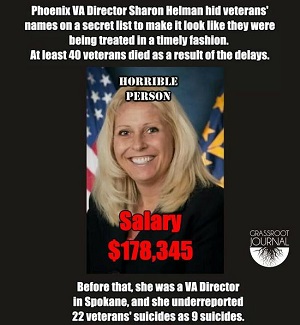
VA Wall of Shame

And the list keeps growing:


[Graphic courtesy Ace of Spades]

MVNHS© Priorities

Compare and contrast:

"More than 250 girls aged 16 and under have had breast enlargements paid for by the NHS ... Across all age groups, more than 3,000 women had augmentation surgery last year"

While bigger may be better, is this really the best use of precious health care dollars?

Ok then, what about a young girl - two years old! - who "was born prematurely and has a form of cerebral palsy which means she cannot use her legs(?)"

Cerebral Palsy is "a term used to describe a group of chronic conditions affecting body movement and muscle coordination. It is caused by damage to one or more specific areas of the brain, usually occurring during fetal development."

Treatment for CP certainly seems like a test-book example of what we call "medical necessity," while breast enlargement seems, at first glance, about cosmetic enhancement. Yet the
Much Vaunted National Health System© is willing to spend who knows how many pounds for the latter, while denying young Sophie any chance at a "normal" (or at least much-improved) life:

"An operation on her spinal cord would enable her to take her first steps – but health chiefs have decided that it is  too expensive."

This is the direct result of government-run health care: no appeals, no accountability. And it is an underlying girder of our own new health care scheme. Think about that.

Oh: if you'd like to help Sophie's family raise the £25,000 ($42,000) needed to pay for the her surgery, click here.

[Hat Tip: Ace of Spades]

Sunday, May 18, 2014

Aloha Obamacare

Aloha is used to express greetings (hello) as well as goodbye. 


Hawaii's two largest health insurers are reporting $36 million in losses during the first quarter and blaming it on fees required by the federal Affordable Care Act.
KITV

Aloha to $36 million.

Hawaii Medical Services Association posted losses of $30.1 million in the first quarter and said it recorded $46.1 million in fees related to Obamacare.
 Kaiser Permanente reports losing $5.8 million and paying $8 million in fees.


Aloha to $30 million at Hawaii Medical Services Association.

Aloha to $46 million in fee's to Washington.

Aloha to Kaiser for $5.8 million.

HMSA spokeswoman Robyn Kuraoka says the company has proposed increasing premiums by an average of 13 percent.

Aloha to HMSA.

Aloha to higher premiums passed on to the policyholders and to the government.

‘A‘ole pilikia

Friday, May 16, 2014

Point of Reference (Pricing)

Over the years, we've documented the phenomenon known as "PARE pricing;" that is, when one is inadvertently treated by an out-of-network provider. For example, you go in for arthroscopic knee surgery, choosing an in-network hospital and surgeon, but it turns out that the anesthesiologist is out-of-network, and you end up being on the hook for full price for his services.

And we've talked about a little known "gotcha" in plans where, even if you choose an in-network provider, you're still forced to pay full price because the procedure or service wasn't a "covered expense." An example of this might be elective plastic surgery.

But what if you go in for a covered procedure, at an in-network facility by an in-network provider, and you still end up paying substantially more than the in-network charges?

This is set to happen under a little known ObamaTax provision called "reference pricing" [ed: well, it might have been better known if the rocket surgeons that passed the bill had read it first]:

"The Obama administration has given the go-ahead for a new cost-control strategy called "reference pricing." It lets insurers and employers put a dollar limit on what health plans pay for some expensive procedures ... One way the new approach is different is that it sets a dollar limit on what the health plan will pay for a given procedure."

Let's stop right there: back in the day, we called these "indemnity plans" (and you still see them around as mini-meds). There would be a schedule of benefits, say $100 for an x-ray, and you were responsible for the balance if the actual cost exceeded this. Fair enough: you knew this going in.

But there is no such schedule attached to "major medical" or group plans, so how is one to know ahead of time? This is especially true for non-scheduled (emergency) procedures.

It may well be a way to "bend the cost curve down," but who sets the "right" price, and how does one determine this ahead of time?

There's another interesting (potential) conflict here: in Ohio, providers are forbidden from balance billing for covered in-network claims. How, exactly, will that circle be squared?

And how many more of these little "goodies" await us in the coming months and years?

Gullible to the Actuaries SWAG

Media outlets and health policy "experts" have been spewing over reports this week about the initial 2015 rate increases that have been submitted in Washington and Virginia. Headlines such as Six Reasons Obamacare Premiums are Going Up Next Year  and Big Obamacare Insurers Signal Big Premium Hikes have been the norm. These articles are coming from the left and the right with very different takes on whether or not Obamacare is increasing premiums. Want to know who is right?

None. Of. Them.

I'm going to let you in on a little secret - initial rate filings mean absolutely nothing. Especially filings for Obamacare compliant rates. Here are five (of many) reasons why we have no idea of what rates will look like.

1. The make up of the market isn't determined. While HHS issued a report on demographics by shopping cart they don't know who has paid, who will quit paying, or how many of the shopping carts were duplicates.

2. Insurance company rate submissions are based on little claims data and a short time frame (experience, trend); so whatever the rates end up they will not be credible. Setting the rates is like predicting the Cleveland Browns will win the Super Bowl in 30 years.

3. States will vary. Insurance markets had different variables for underwriting pre-Obamacare. This will lead to some having lower increases than others. Some states will also have a different make-up of enrollments. A state with a higher population of younger people might have a lower increase than one with an older population. Unhealthy states may see higher increases simply because the underlying risk is greater.

4. Speaking of pre-Obamacare, rates that were set last year assumed that nobody could keep the plan that they liked. By unilaterally changing his own law, President Obama actually distorted his risk pool. People in good plans that are healthy will stay in those plans where allowed. Because of community rating the medically underwritten plans that have good risk will be priced lower than the Obamacare mandated pool that must be equal regardless of health status. Why go into the peed in baby pool when you can stay in the less peed in pool?

5. The blanket figures in these studies use an aggregate number. This tells us little about how the rates will look for different metal tiers. 8% doesn't mean the increase is equal for Bronze, Silver, Gold, and Platinum tiered plans. Bronze plans might be 3% and Gold plans might be 15%. One carrier might also have a larger market share today and decide to eliminate Platinum plans because the risk in these products is very high. By simply eliminating a plan it could have adverse impact on their Gold plans or on their overall market share.

Rate watching is important. But before the MSM start throwing stones at each other remember, because of these and many other reasons actuaries are using SWAG as their calculation method.

In other words they are making a Systematic Wild Ass Guess.

The Richdoctor Myth Revisited

Several years ago, I posted on the myth of the "Richdoctor,"  a myth that is really about wealth envy and isn't supported by the facts. Fast forward a few years, and the effects of the myth have escalated. Fortunately, not everyone buys into it.

As an advocate of increasing physician reimbursement, it is refreshing to read an article in support of physicians being able to make more money. In “Why Primary-Care Physicians Need a Minimum Wage," Daniela Drake makes an argument for better pay for physicians:

[T] the health insurance calculator for Southern California says a 62-year-old would pay $7,200 a year for the top plan. Most people resent paying this big a fee for something like insurance — and it’s easy to see why patients can be manipulated into thinking their doctor is being overpaid.

However, the math is simple. The average PCP has 2,500 patients and supposedly makes $180,000 a year. Therefore, the insurer is paying your primary care doctor $72 a year per patient — out of the $7,200 a year paid to the insurer. That’s 1% of the insurance premium. It works out to $6 a month (19.7 cents a day!) to have a highly trained professional overseeing your care
.”

Wow, these number are depressing, but due to two errors in her calculations, the reality is actually much worse.

First, in regards to her example, she makes the assumption that a PCP (Primary Care Physician) only sees each of their patients once a year. So a patient load of 2,500 patients seen once a year would be a daily average of 10 patients. The reality is that most PCP’s see well over 30 patients a day, which is 7,200 a year.

Second, that $180,000.00 is only 20% of what the physician is actually paid. In medical office settings, 80% of the reimbursement paid to physicians goes into overhead, staff salaries and government mandated programs.

So let’s redo the math based on the realities of medicine today:

If $180,000.00 is 20% of the total reimbursement, then a PCP brings in $900,000.00 a year. Therein lays the misconception that doctors are overpaid, but remember: the doctor does not pocket that total. At a patient load of 7,200 patients that is $125.00 for a 15 minute appointment. This is great pay. But remember also that 80% of that total goes to pay the staff salaries and benefits, rent, utilities, as well as such government mandated programs like Electronic Medical Records and all other costs needed to keep a business running. So, after the doctor pays his bills he is left with $25.00 per appointment, which at 7,200 patients a year is $180,000.00.

So in her example she states that physicians are paid $72.00 per patient encounter, but the real number is $25.00 per patient encounter. I do agree with her statement that this is a bargain to have a highly trained professional oversee your healthcare:

"To have someone like that available for you at 19 cents a day [reality: it is closer to 10 cents a day] would strike most people as a bargain."

Ms Drake then goes on to quote Uwe Reinhardt, an economics professor at Princeton (about whom Mike has also written). Professor Reinhardt "has argued cogently against physician salary reductions and for salary raises. “Physicians collectively [earn] 20% of total health spending,” he wrote, “half is absorbed by practice expenses… physician’s collective take-home pay [is] only about 10% of total national health spending.”

Reinhardt points out that physician pay is such a small fraction of health care expenses, it wouldn’t do much good to cut it. In return we’d get “a wholly demoralized medical profession to which we so often look to save our lives. It strikes me as a poor strategy,” Reinhardt wrote. “A superior strategy might be to pay them very well for helping us reduce unwarranted health spending elsewhere.
”"

This article is a great way to begin discussing the realities of how little PCP’s - and all physicians for that matter - are actually paid for the services rendered. However, instead of a minimum pay, which is more government intrusion, the best solution is to let competition set the charges, as is done by all other service providers:

Let’s look at hair stylists; have you ever seen a Government fee schedule for haircuts? Of course not! Each salon sets their prices and the customer chooses. The argument against doing this for medicine is that health care is a "right;" that doctors will make their prices so high that the paying public could not afford care. Going back to the hair stylist, why don’t they charge $150.00 for a haircut? Simple: people would not pay it and some stylist would learn that if they charge $45.00 for a haircut then they will get the customers. It is simple economics. Prices will stay low due to competition. I know that this is a radical idea, but how long before the best and brightest of our population learn that it is economically impractical to go into medicine?

In-and-Out Info

So, some ObamaTax news from different ends of the spectrum:

OUT - So you don't want to buy a health insurance plan, but you also don't want to pay the fine penalty tax surcharge; what to do?

Well, you could apply for an exemption. Ms Shecantbeserious and her helpful minions have made available a downloadable guide to the ins-and-outs of qualifying for a get outta jail free card.

Your tax dollars at work.

IN - On the other hand, you decide that yeah, it'd be a good idea to buy a plan after all, but the next Open Enrollment Period is still months away. Isn't there some way to open up one's own little enrollment period?

Indeed there is (or may be); Aetna helpfully emailed with a reminder that there are several different events that could "trigger" a Special Open Enrollment, including:

Permanent Move - this one may be tricky: you'll need to provide proof of both prior and new residence locations.

Employer's Bankruptcy - this is aimed specifically at retirees who were covered by a former employer's retiree health plan.

Birth - this would trigger a Special Open Enrollment Period for the entire family. But beware of timing!

Can I get fries with that?

Thursday, May 15, 2014

While You Are At It

The failure of hc.gov (the Obamacare exchange) is notorious (and it still isn't fixed). Less
publicized are stories about the number of state exchanges built with federal tax dollars.

Not only were many of the state exchanges not "shovel ready" but most seem to be almost as inoperable as hc.gov.

A couple of U.S. Senators want their (our) money back.
HHS awarded a total of $4.7 billion in exchange construction grants, act supporters say, citing Congressional Research Service figures.
Four exchanges facing significant problems have spent $474 million in grant money, supporters say.
“It’s only fair that states have to pay American taxpayers and the federal government back for their total incompetence,” Barrasso said in a statement.
Great idea.
Now how about a refund to the taxpayers that funded this mess to the tune of $1 trillion?